We had the pleasure of meeting Joris Corthout, CEO of Prismax, a Belgian creative studio whose most exciting chapter is yet to be written.
What constitutes the DNA of Prismax and how is this reflected in your work?
Craft plus invention — that's the shortest answer I can give.
Prismax started in 2005, the same year as Tomorrowland, and we grew up side by side with them: from mixing visuals in a booth to designing entire worlds. Today we're about thirty-five people, and roughly half of us are artists and half are engineers. That balance is the DNA. We don't hand a beautiful image over to a technical team and hope it survives; the people who imagine it and the people who make it run at 16K sit in the same room.
The second part is that we always start with the story, never with technology. The first question on any project is not ‘what screen is it’ but ‘what should the audience feel at minute forty?’ The technology is only there to protect that feeling. And because our niche is so specific, half the time the tool we need doesn't exist yet — so we build it ourselves. That's why every production has to push both the art and the technology one step further.
What does a typical day look like in the life of a VJ at Prismax?
Honestly, there is no typical day — which is exactly why people do this job.
A studio day is quiet and precise: building environments in Unreal Engine, matching them to the exact geometry of a physical stage down to the centimetre, previewing the result in VR so you can literally stand inside the show before it exists, then programming timecode, DMX, OSC and MIDI so that video, light, lasers and pyro breathe as one thing.
A show day is the opposite. Load-in, calibration, rehearsals with the lighting and laser crews — and then those hours where you are not playing back a file, you are performing. Our worlds are computed live, so a VJ shapes intensity, colour, camera and rhythm in the moment, reading the artist and the crowd the way a musician reads a room.
The best illustration I can give: at Tomorrowland this summer the drought banned all pyro on the first weekend, so our VJs performed digital fireworks on the screens instead. Same night, new instrument.
Where does your inspiration come from to create such crazy and surreal universes?
It starts with music, always. A track has a shape — tension, release, silence — and if you listen to it properly it tells you what the world should look like before you draw a single thing.
After that, honestly, everything: nature and deep-sea documentaries, brutalist architecture, science fiction, game art, classical painting, the way light behaves in fog. Everyone in the studio collects the things that made them stop scrolling, and those references collide in ways nobody planned.
The most underrated source of inspiration, though, is constraint. A stage has a shape. The Sphere is a 180° dome. A wall on a yacht is four metres wide. Those limits are not the enemy of imagination — they are the thing that makes an idea specific instead of generic.
And then there is the team. Thirty-five people from very different backgrounds pulling at the same idea will always end up somewhere stranger and better than one person with a moodboard.
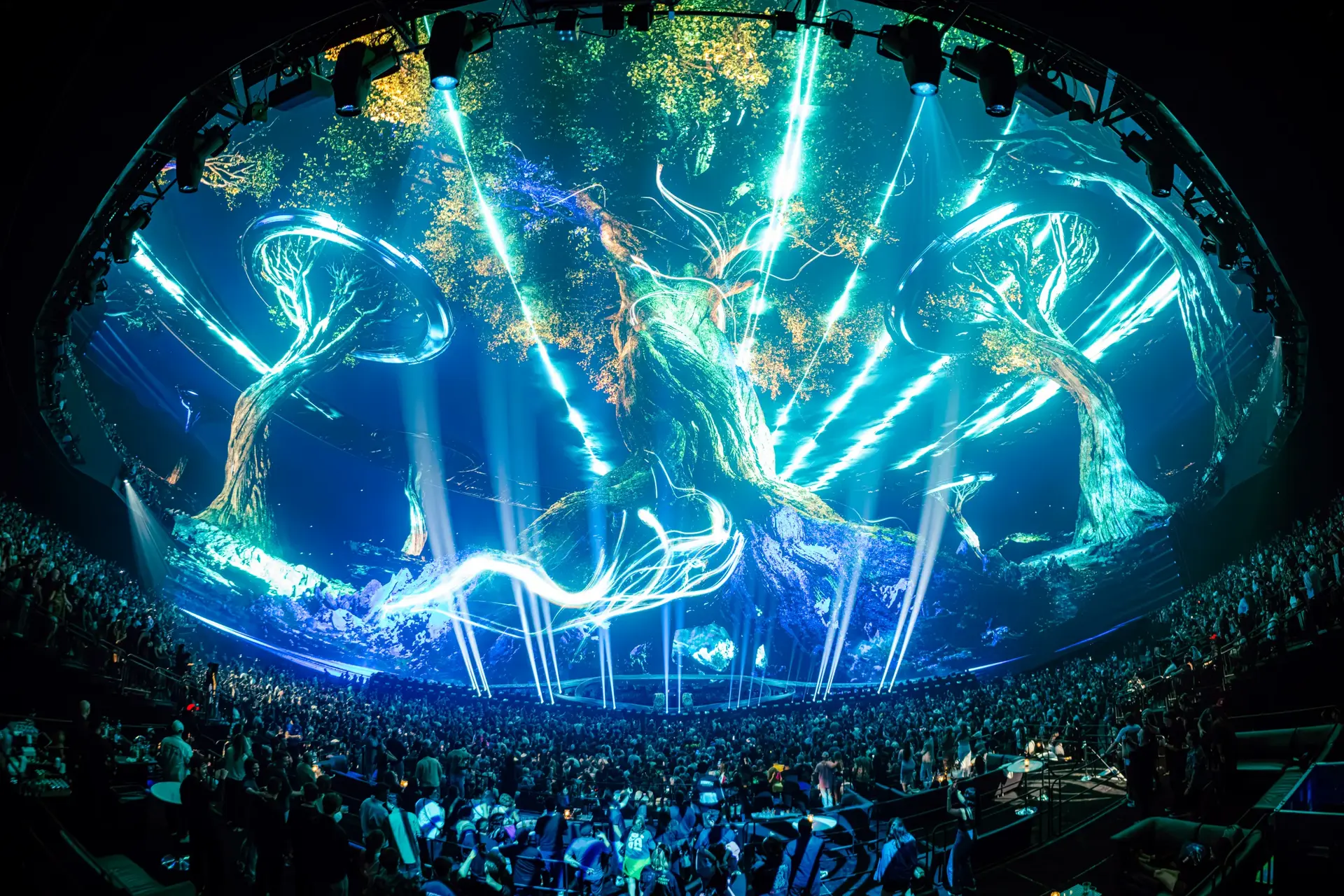
The visuals you create are truly stunning. What are the key steps to achieve such a level of quality?
Five things, in order.
Story first. We refuse to open the software too early. A brief usually arrives as a feeling — wonder, grief, euphoria — and we translate that into worlds, colour languages and rhythms before a single asset is modelled.
Art direction with teeth. One visual language per show, held across every scene, so the night reads as one piece and not as a playlist.
Real time. Before, if a director wanted the forest lighter, we rendered for forty-eight hours. Now we change a parameter and look at it together. That one change is what raises quality — you get hundreds of iterations instead of three.
Previz in VR at one-to-one scale, so mistakes are found while standing inside the show, not on opening night.
And then rehearsal — an enormous amount of it. The last ten percent of quality is always found by performing the thing over and over until it feels inevitable.
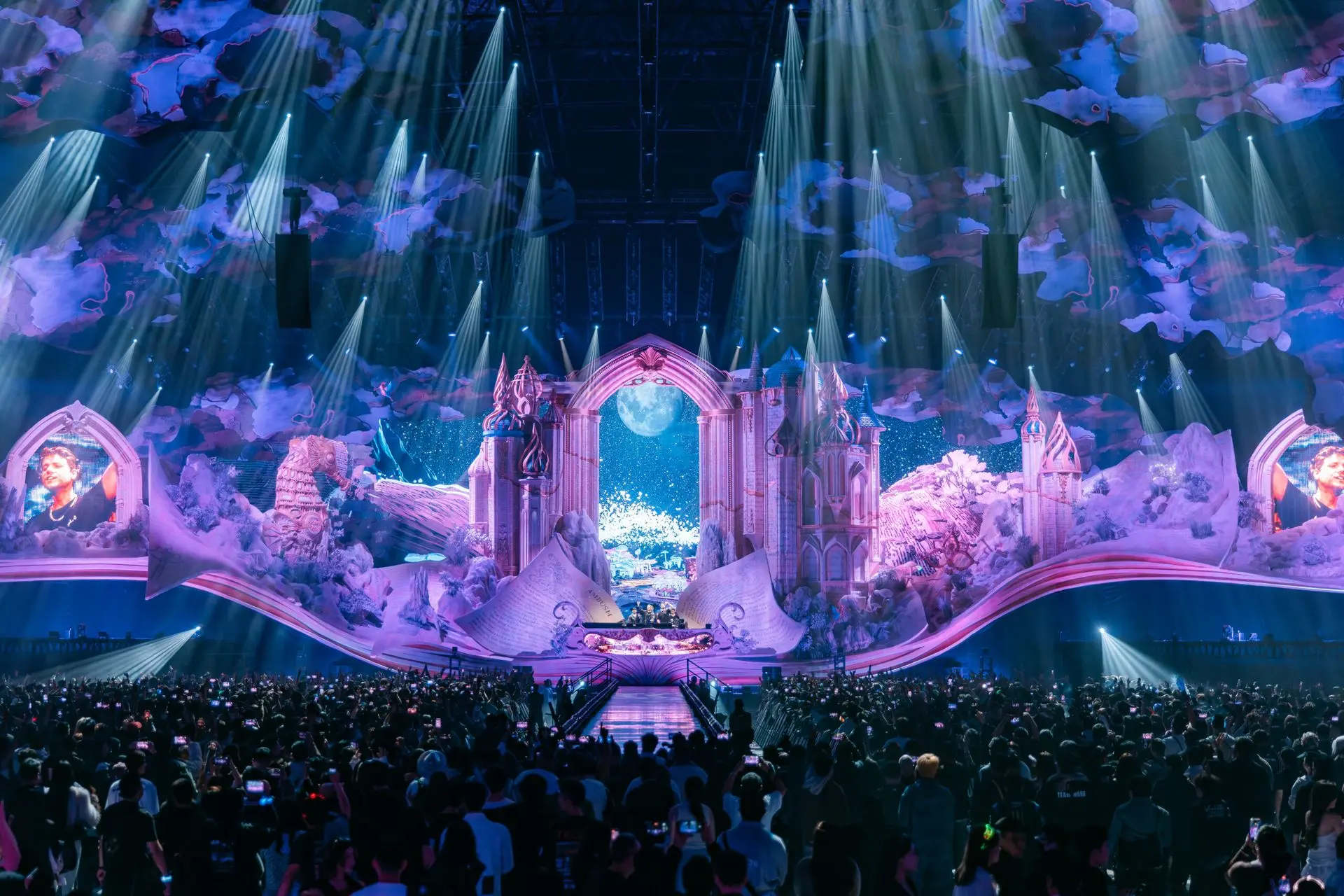
We saw your partnership with Insomniac for the Unity concept, which brought to life an extraordinary visual and musical show. What are following you the key ingredients for a successful collaboration?
UNITY started with a phone call. Tomorrowland and Insomniac had each been thinking about the Sphere, and instead of competing they decided to build something together. That spirit set the tone for everything that followed.
Three ingredients, for me.
First, a shared creative language agreed early — we spent real time defining what the night should feel like before anyone argued about pixels.
Second, respect for what each side does best: Insomniac brought Beyond Wonderland, Escape and EDC, Tomorrowland brought Orbyz, Planaxis and Adscendo, and we brought the ability to make all of it live and breathe inside one room.
Third, trust under pressure. A thirty-person team, a hundred and sixty-five minutes of show, 16K by 16K, more than a petabyte of data — that only works when nobody is protecting their ego.
And the best partners push you. Nobody else pushes our technology as far as Tomorrowland does, and honestly that is a gift.
You offer visual experiences in the metaverse and also utilise Unreal Engine. Can you tell us more about that?
It started almost by accident, during Covid. Live events disappeared overnight, and Ruben — my business partner and our CTO — ended up messing around in Unreal Engine. At some point we realised the thing we were playing with could actually do our job.
We pitched Tomorrowland a virtual festival. What was meant to be a stage or two became Pāpiliōnem: eight stages, around a hundred DJs, an entire island rendered in real time. We never went back to pre-rendering.
That project made us a certified Unreal Engine Service Partner for virtual production and earned us an Epic MegaGrant, which we used to build xLive — our own real-time show engine.
For us, ‘metaverse’ was never about avatars and land. It's about worlds that exist as living data rather than finished video. The same world can be a festival mainstage, a VR experience, a broadcast set or a digital twin. You build it once, and then you can perform it anywhere.
Alongside the virtual aspect, you also cover visual immersion through live events. How does such a project unfold?
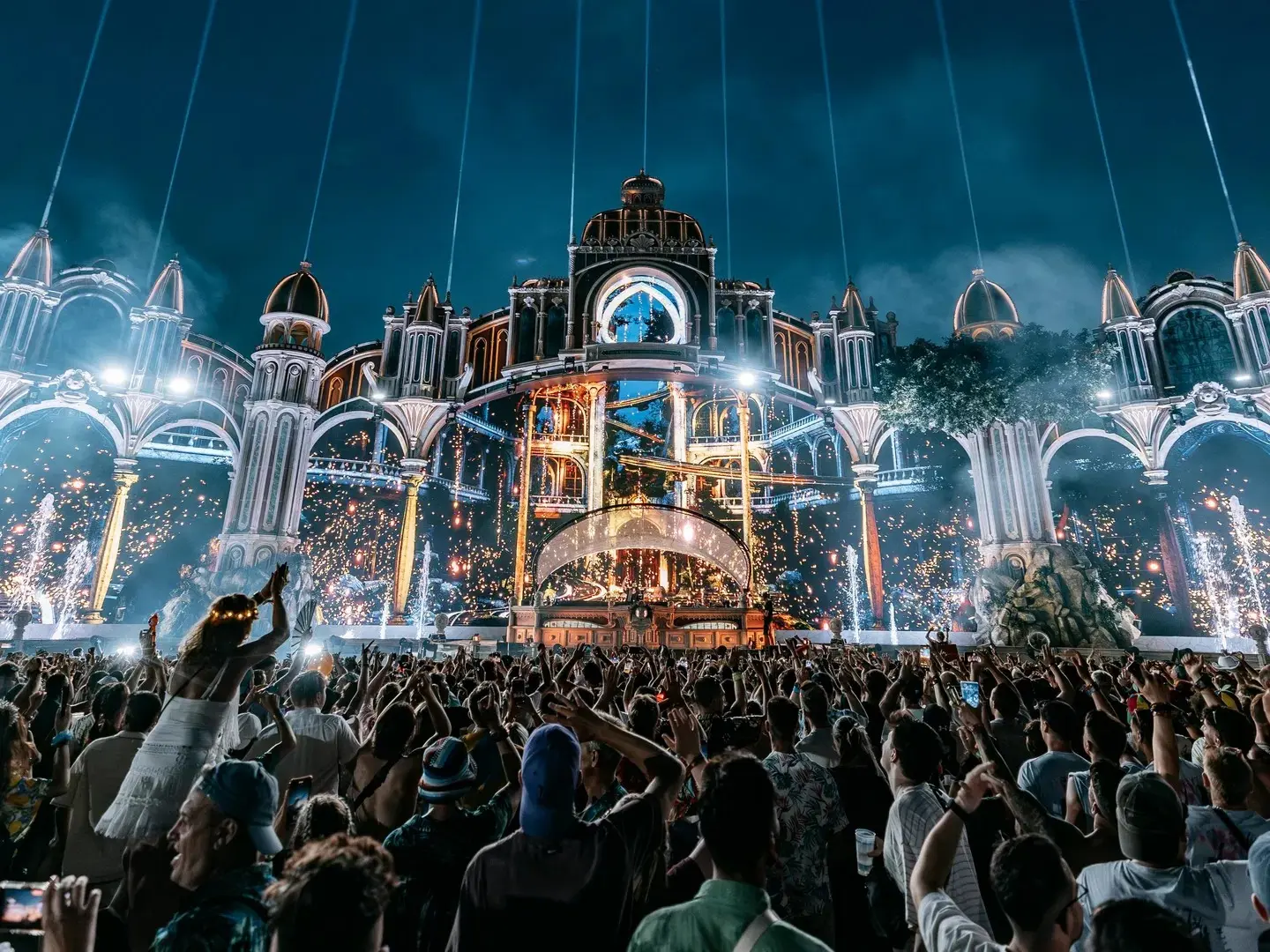
It usually starts with a conversation and no specifications at all — a theme, a feeling, sometimes a single word. This year at Tomorrowland it was ‘Consciencia’: six monumental faces, six primal emotions.
From there: concept and art direction, then a 3D model of the physical stage so that every element lands exactly on the real structure. Then months of world-building, back and forth with the client's creative team. Then previz in VR. Then integration — media servers, timecode, lighting, lasers, pyro — and rehearsal on site.
And then the part people tend to forget: the show isn't finished when the content is. Our worlds are computed live, so every night is performed and adapted to each artist and each crowd.
That flexibility is also our insurance policy.
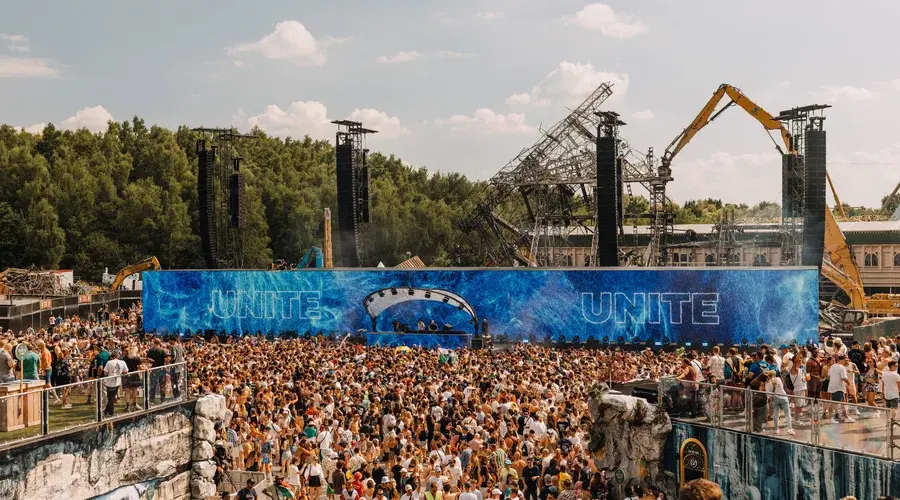
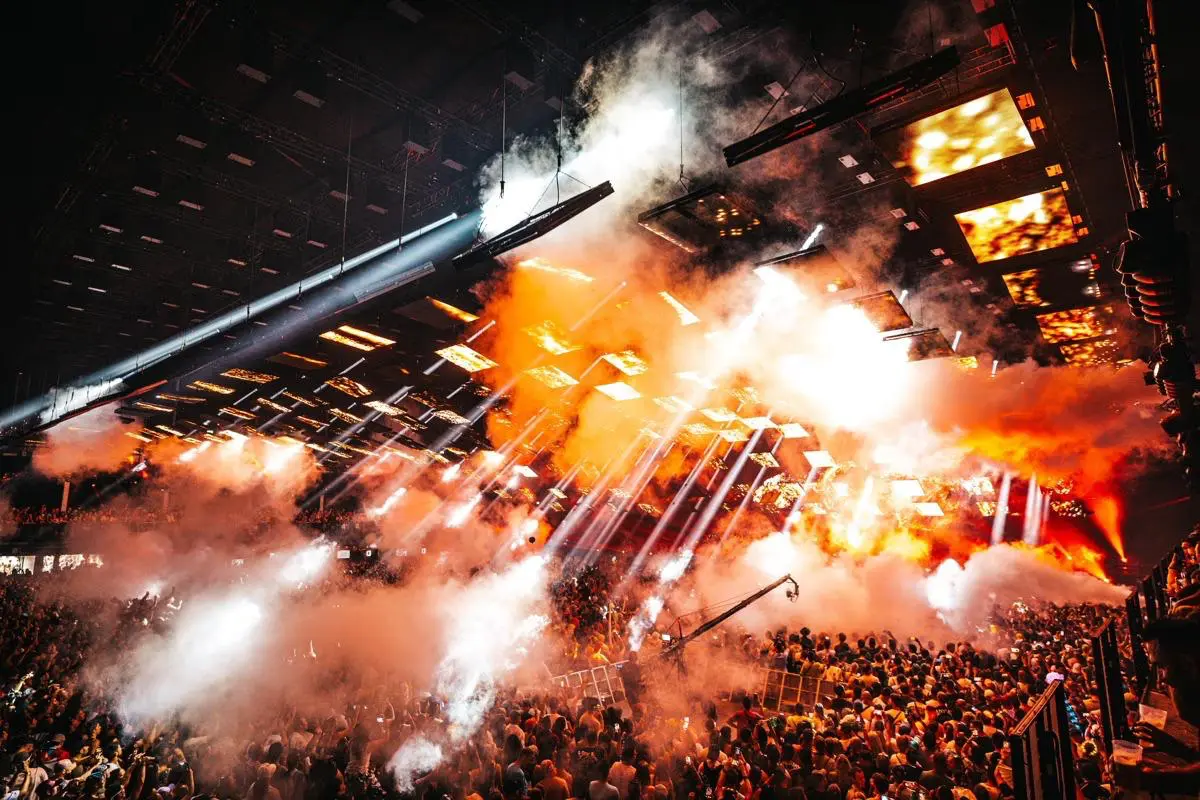
Your creativity seems to know no bounds as you also offer virtual set design and digital arts. How are these approaches complementary?
They are not four different businesses — they are four frames around the same craft. Everything we make is a real-time world; what changes is where you are standing when you look at it.
Put a camera and a green key in front of it and it becomes a virtual set: we built the studio VRT used for the elections and the Olympic Games, where the entire environment changes on the fly.
Put it on a wall and it becomes digital art — together with Van Berge Henegouwen we launched Immersia, which turns a room on a yacht or in a home into a forest, a city or a moving painting, with sound, airflow and scent to match.
Put it on a mainstage and it's a festival.
The skills compound. A shader written for a broadcast studio ends up in a Sphere show; a lighting trick from a festival ends up in someone's living room. That cross-pollination is the whole reason we keep it under one roof.
What is your vision for the spectacular show of tomorrow?
I think the era of playing back a finished video is over. The show of tomorrow is live in the real sense of the word: computed in the moment, different every night, responding to the artist, the crowd, even the weather.
Second, the screen stops being a screen. At the Sphere the venue itself becomes the instrument — 16K across a 180° dome, plus haptics in the seats, scent, moving air. Immersion is not a resolution number; it's how many senses you're willing to commit to.
Third, and this is the one I care about most: scale is basically a solved problem. Anyone with a budget can be big. What stays difficult — and what will separate the shows people remember from the ones they don't — is emotion.
Knowing when to go quiet. When to hold a single image. When to give the audience room to feel something.
Technology, AI included, belongs inside the pipeline, speeding up the parts nobody enjoys. It shouldn't be the author.
Will the audience be given a little teaser of a project that will be launched soon?
The thing I'm most excited about isn't a single show — it's xLive, our real-time show engine, finally going out into the world properly.
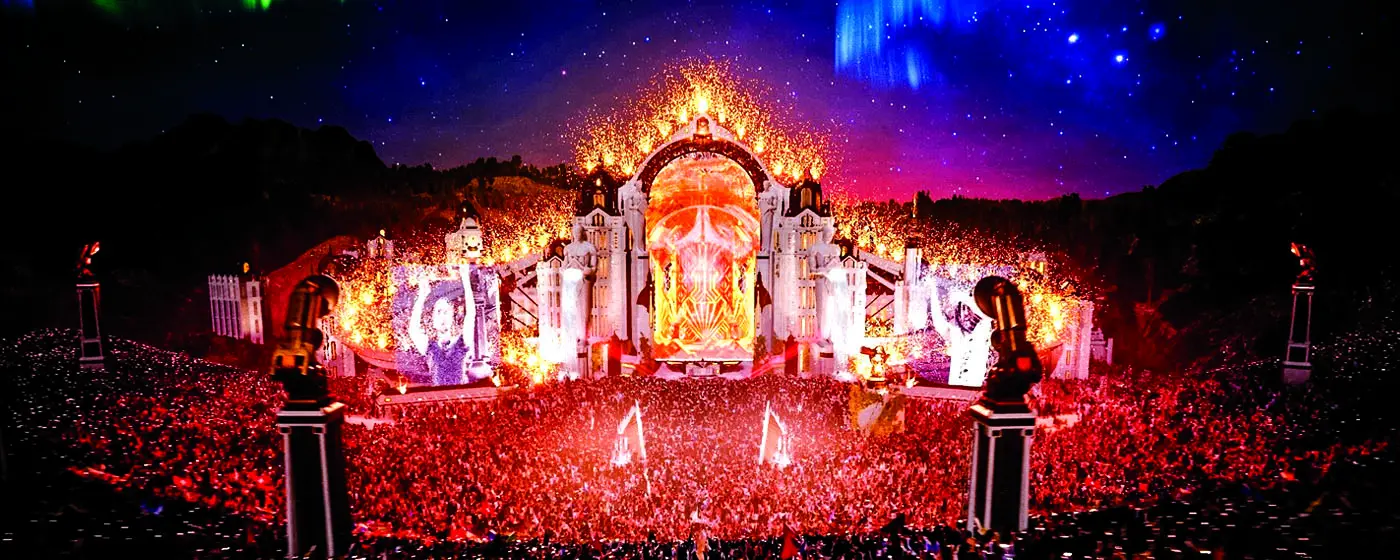
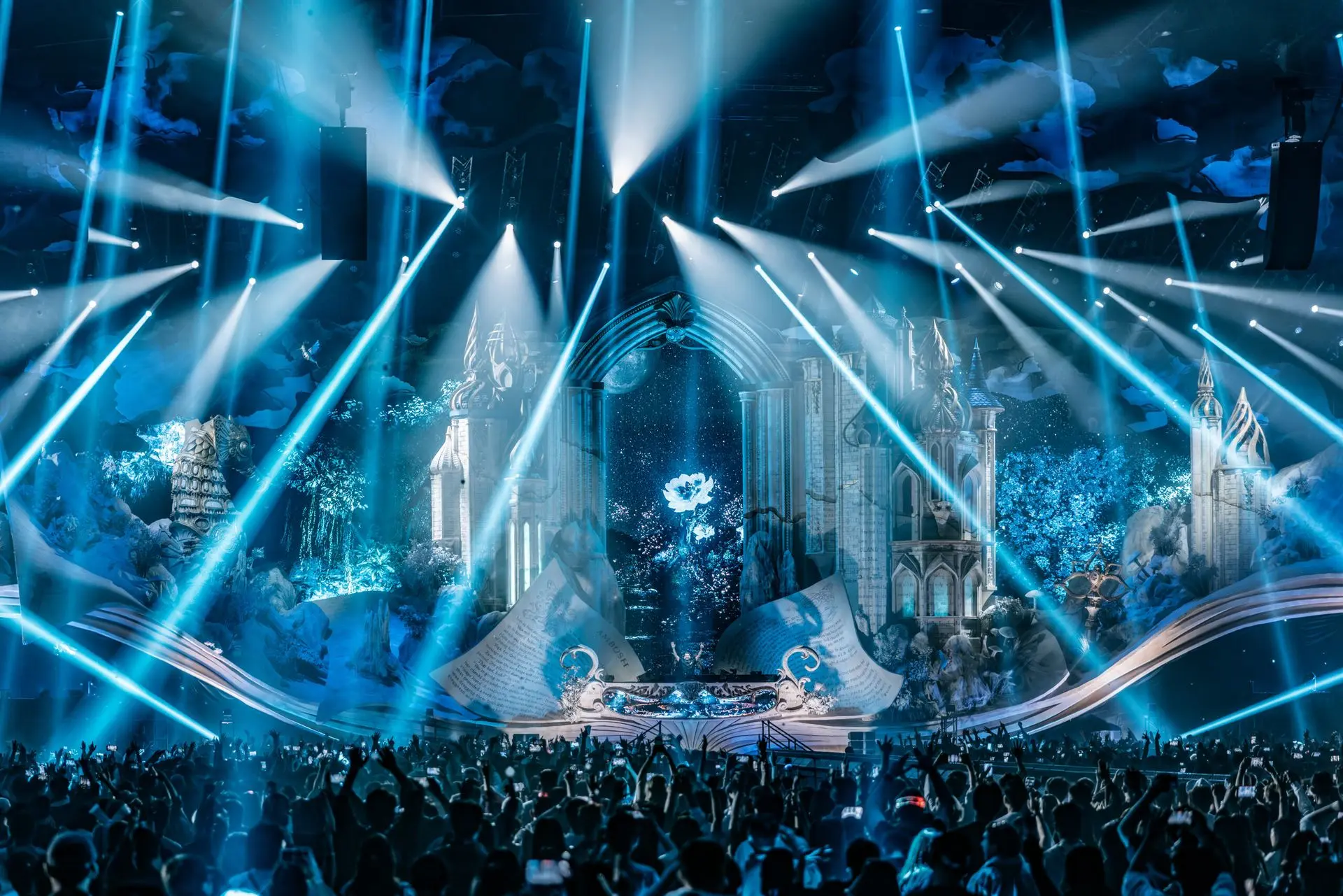
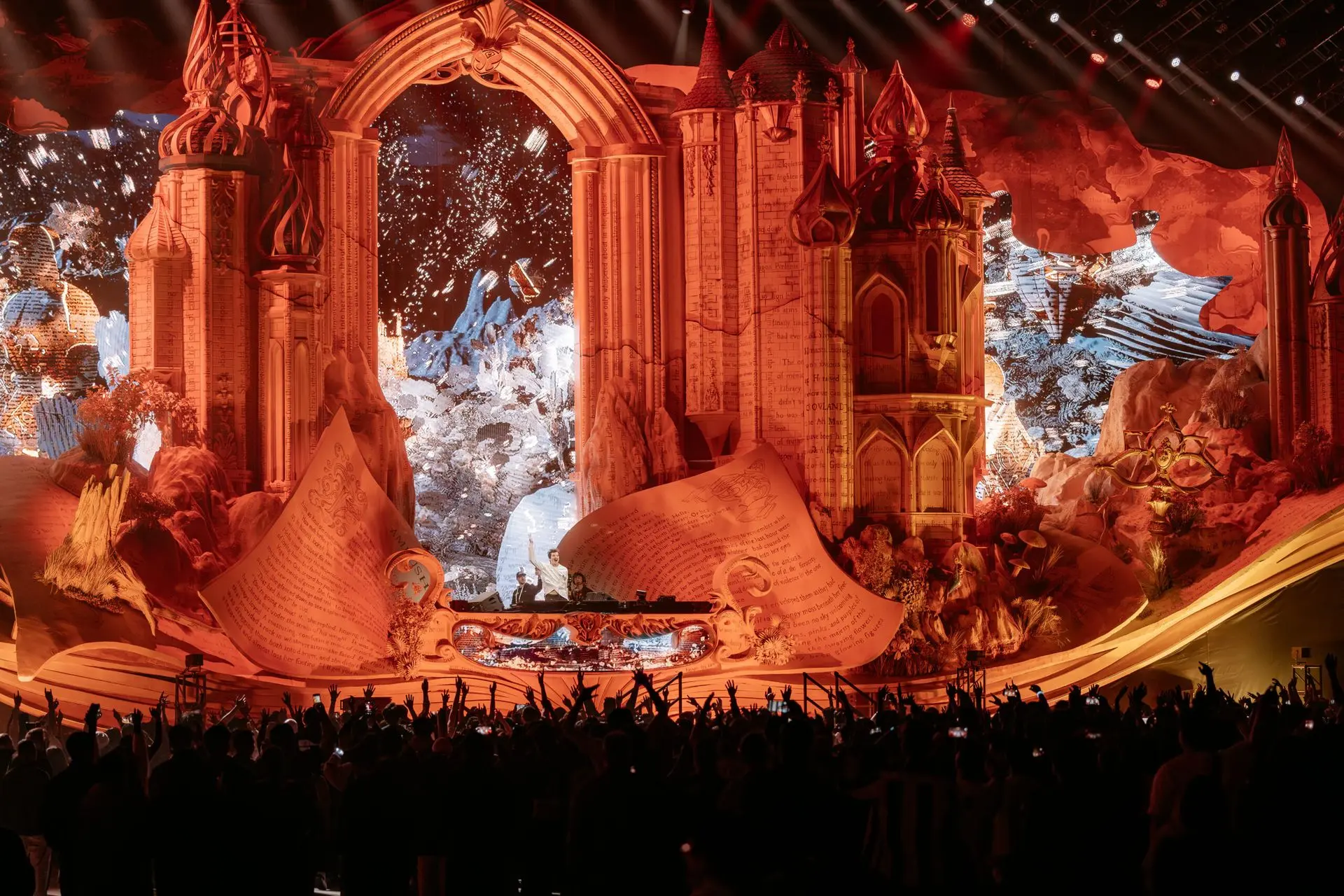
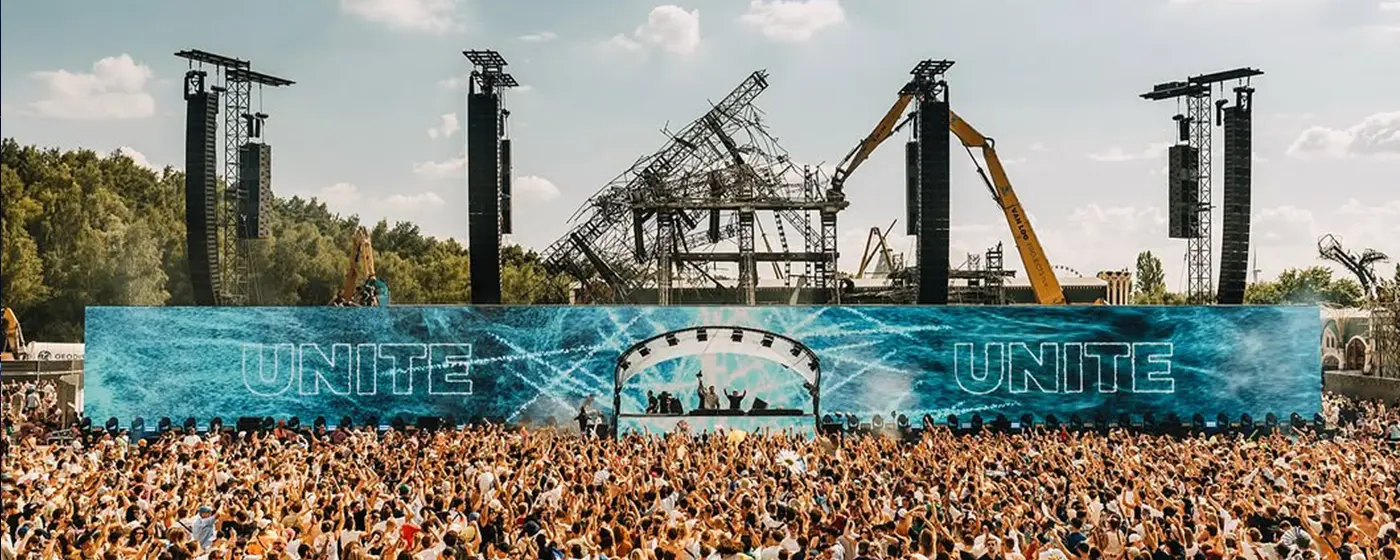
Until now it has been our secret weapon. It's what lets us perform Tomorrowland's mainstage live rather than play it back, and it's what made UNITY the first fully real-time production inside the Sphere.
Over the coming period we're taking it well beyond our own productions: dome and Sphere-scale venues, broadcast studios, permanent immersive installations — so that other creators can perform their visuals instead of pressing play.
Alongside that, we're building the infrastructure for the next generation of Sphere-scale venues, and expanding Immersia from superyachts into residences and private spaces.
I can't say much more yet, but I will say this: there are a couple of productions in the pipeline for the coming years that are the most ambitious things we have ever attempted.
Keep an eye on us.
Last but not least, if there’s something more you’d say to our readers, what would it be ?
Two things.
To anyone starting out: don't chase the technology, chase the feeling. Tools change every eighteen months — the ability to make ten thousand people go quiet at the same moment doesn't. Learn music, learn timing, learn story. The software will follow.
And to everyone else: come and stand in one of these rooms. You can watch our work on a phone and it looks nice. But immersion isn't a video — it's your peripheral vision giving up, your body reacting before your brain does. That doesn't survive a screenshot.
We're a studio of thirty-five people from a small country, and this year we've been performing live inside the Sphere in Las Vegas.
That still amazes me.
So: be ambitious about what you make. There's a lot more room out there than people think.